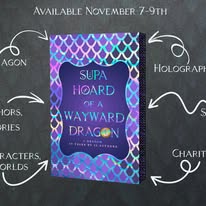
In case you missed it, last November I got to be part of an author fundraising project Supa Hoard of a Wayward Dragon. (Thanks to my author friend R. Leonard for the book link and for being editor-in-chief of the project. 🤗) This anthology brought together 15 diverse authors for a limited edition (i.e. single print run), beautifully presented, fantasy anthology that followed the story of a dragon and its coin.
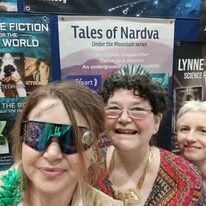
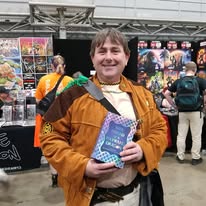
Copies have sold quickly, but word on the street is at least one author, A. L. Tippet, still has a “hoard” (🤣) of books, if you’re keen for one of your own. Launched at Brisbane Supanova 2025, the contributing authors (me and the Rendered Realms crew included) had a bit of fun with 3D printed dragons with coin in hand … er … claw. Many of us dressed in character and we even had a roving author readers had to chase down for a full complement of signatures (thanks, Mark!).
For those interested, my contribution continued Vivia’s adventures from ‘Over and Out’, my short story in the Crossed Spaces anthology. Our favourite Aussie with attitude is back in Australia after her international misadventures with Nathan, her in-the-flesh Texan ranger … sort of. In ‘Seeded Storm—A Virtual Mirage’ Vivia and her ninja hacking team have to infiltrate a seed bank. Enter a virtual dragon inseparable from its personal bitcoin, and the trouble has only just begun.
If you want to know more, you’ll just have to hunt down a copy.😉
Much has been said about vanity in writing circles over the years. For those not in the know, vanity press is a deceptive front that pitches “publication” to unwitting writers desperate to see their work in print, but delivers little-to-none of what they promise. These scammers deliver a poor product with zero marketing reach and often include a contract that holds you captive if you ever want to see your book on a shelf. The classic tell (usually shortly after manuscript receipt) is, “Your work is a standout in the market and we’d love to publish your [insert appropriate manuscript type].” Fawn, fawn, fawn.
But then comes the clincher. “You just have the raise the money …”
That, my friend, is not publication, but predation (in the literary sense …).
Traditional publishers do not ask for money to “publish”. Neither do they offer publication tiers nor require you to purchase a certain number of books (especially a significant number) post-publication. These moves suggest an entity is trying to resource the project with your money whilst trading on the fact they APPEAR to be traditional, whilst really trapping you in a financially unviable book deal. (Hate to break it to you, but books are not the money maker everyone imagines.) Also beware of the non-disclosure clauses on discussing the conditions of your contract with anyone.
However, this is not to be confused with author services.
Author services are agreements between a writer and service provider, offered for a fee. Said writer asks for said service [insert cover design, or editing, or typesetting etc], doles out the agreed monetary equivalent, but retains the rights of their work. The writer can also request production services, like printing, and refuse recommended editing (or anything else) for their “precious” (for those Lord of the Rings fans) and release it to the wild raw—and that is seldom a good thing. But it is what it is.
Unfortunately, some folk struggle to delineate between these two categories and pull a Joan-of-Arc type move on anyone they believe is engaging in vanity publication, even when they’re just providing (or receiving) a requested service. The consequences of such character assassination can be far more damaging than that of vanity publication … But I digress …
Recently, I’ve encountered vanity in an entirely different manner. Marketing.
Photo credit: Shaarc, Pixabay, pixarc sad
Daily, I receive cleverly crafted emails assuring me my books are a gift to the sci-fi loving masses, all rooted in the commonality of shared moral conflict and the internal grappling of humanity. (Apologies to any of you whose genuine emails have been buried in this flux of adoration of my transcendental storytelling skills. 🙌)
Honestly, the hooks are extraordinarily appealing. These contacts (who all have gmail accounts, interestingly) have mined (by AI, no doubt) the guts of each of my stories, along with anything and everything I’ve ever written online. The knack is, like any other AI information source, to tell you exactly what you want to hear. Primarily this is in a way that overwhelms you with dopamine-stimulating words to shut down reason and lure you towards that sell.
Books clubs. So many online book clubs with thousands of readers gripped by my science-fiction character’s deeply human plights, all hungry to read that next page. (Funny, I never see this translate into sales … 🤔) And if you humour them, because it’s honestly rather fascinating, eventually the flattery comes down to paying a “modest” administration fee (then translate to $US) for this career-changing opportunity. Really, if they were that keen, they’d buy the book en masse and put up the reviews. Maybe then I’d take them seriously.
Then there’s the film pitch—because every author wants to see their stories on screen. And I (yes, me!) was the one they chose? What favour! Just reply. Or click the link. (No, don’t!)
And the marketing pitches around SEO. Again, awesome breakdowns and descriptions telling me all about me and my work from the online AI sifting, with the final punch being the lack of reach and a startling absence of reviews proclaiming the glory of my talent. Sad, isn’t it? (And, honestly, it is a little …)
But it’s fake. A scam to engage and take whatever it is these grifters are seeking. And it all plays on humans’ inherent need for validation and an unpinning desire to be affirmed. With writing an isolating venture, it is often just what an author struggling to get traction wants to hear.
In our egocentric world, there are plenty of gimmicks willing to take advantage of our own vanity. I even receive frequent emails from world-famous authors wanting to link up. (Yeah, right.) If it seems too good to be true, it often is. Stay wise and receive such flattery with caution before clicking reply. And if someone really has thousands of bookish sci-fi fans desperate to take a deep dive into my novels, in the words of Eliza Doolittle, “Show me!” (I’ll keep an eye out for all those royalties and spontaneous reviews—thanks in advance. 😉)
For those who have watched the movie “Mom’s Night Out“, remember that line by Sarah Drew’s character: “I am a mommy blogger”? (For those of you who haven’t seen this movie yet, get out from under your mushroom and go find a streaming point! Total classic.) Well, today I’m having to do the same, only with a slightly different bent: “I am an author blogger”— because right now I have FAILED my loyal readers and blog followers.
(Insert copious tears, wails and general sounds of sorrow.)
YOU should have been the first to know I HAVE A NEW RELEASE!!!! Shamedly, I only announced it only on social media and a GUEST CWD blog, before making general reference on my welcome page. I’m so SOOOORRRY!!!!!
To catch you up, I have FINALLY released Jett Faraday’s story, Flare Up. This cracking conspiracy adventure crosses gym culture with unrequited love, in a superhero origins-esque science fiction ride that will make the wait so worthwhile. At least, I think so … but I might be a little biased. And the cover designed by my author friend KA Hart, is AMAZING!!!!!
In making this announcement official, I went back and revisited a previous blog on fitness and bodybuilding, which are Jett’s passions—that, and ice cream. Which takes me back to the three and a half years I dropped dairy (and other things) from my diet … Let’s just say the world is a better place with dairy in it, especially ice cream … but I digress …
Below is a link to that interview with real life fitness and bodybuilding guru, Matt Betts, who after all this time is still a fitness legend and all too familiar with the reality of “… [e]nough bronzer to suffocate a cat …” (to quote Sophie—not that we’re suffocating anything here, to be clear).
So, make sure you get your hands on a copy of Flare Up, read it, and leave a review for your trouble. (When you give an author some love, they do fun things like write more stories. Woohoo! 🥳) I hope you love reading it as much as I enjoyed writing it. And don’t forget to check out that interview with Matt below. Ciao!
I recently overheard a conversation referencing AI document drafting. I wasn’t particularly paying attention, for as a writer, I have an appreciable dislike of the pervasive insertion of AI into every conceivable electronic activity. Not to mention I was one of those hapless authors whose books were used to “train” AI. No permission. No compensation. Just total hock off. Insert angry face emoji. 😡
Image Credit Pixabay: justDIYteam
Being an author of little notoriety is even more the kicker. My voice is a blip against the ever-burgeoning appetite of the AI monster making an ugly attempt to dislodge and/or impersonate humans in countless roles: professionally, personally, and now even medically, including mental health advice. I kid you not, having recently seen a shiny new “option” of speaking to an AI counsellor as a support package for workplaces … 🤢 What could possibly go wrong … 🤦♀️
Some people love using AI. Bully for them. And I get it can be useful in certain contexts. For example, an image I’ve used in this post is AI generated. Were AI not being poured on us like itching powder, I may have less discomfort over its use in various applications, especially as a tool. But when copilot appeared on all Microsoft applications I felt compelled to add my disgust to the Microsoft chats flooded with disgruntled users objecting the inability to permanently delete this unwanted “feature” from applications. Instead of fixing this, copilot and other AI bots began popping up increasingly, to the point where I’ve seriously considered the advice of a friend when encountering irreconcilable issues with a PC—throw it out the window!
(Given I’m typing this post, I clearly did not, but I tell you, I’ve been tempted!)
But that’s where that overheard conversation I mentioned above took an interesting turn. As I was about to zone out, one of the participants expressed how much they preferred reading documents self-drafted by the other individual. Why? They had such a lovely way with words. It was a beautiful statement that gave me pause.
That’s when it hit me with the clarity of polished crystal—if we let it, AI can rob us of our voice. You see, the thing AI lacks is … us. Our unique voice. Our undigitalisable thoughts and emotions. Our human irrationality. Our desire to create. Our deep reverence for that which is holy and fully of beauty. Our need to build meaningful relationships. And our need to express what has been deposited in us to the world.
By ceding our communications, investigative ideas and storytelling (and more) to AI, we risk allowing our voices to be stolen by a clever program. And there is not one human, creature or bot in the world that can replace what you and I alone carry and are called to share with those around us, in this exact time and place in which we live.
Photo Credit: Pixabay
I can’t tell you how to use AI tools. Maybe it’s been a task saver for you or valuable in ways I can’t imagine. (Online searches, and spellcheck—yeah, yeah, I suppose that can definitely be helpful …) I know some authors who are even experimenting with it for accelerated drafting and other creators who have had great fun with AI-blending of visual art concepts. Whichever way you choose (or not! 😉) to engage with this technology, I hope you never use it as an excuse to relinquish opportunities to raise your voice and release your creative power in this world, in whatever medium that is. How tragic it would be to allow something so precious to be replaced by a tool that’s not even human. Your unique voice is valuable and worth being heard. 💗
I was recently reflecting on an email I received some years back from “Blaine Colton”. Ha, ha, bots. Good one. Like I’m falling for that. Designate message to <spam>. Awkward moment when a month or two later I was checking the junk box and accidentally clicked on this email, only to realise it actually WAS from Blaine Colton! Whoops.
This Blaine Colton had discovered their namesake as the hero of my trilogy and written to share this fun fact. Red-faced and sheepish, I replied with profuse apologies for the misdirected assumption and consequential delay in reciprocating their email contact. Thankfully, they took it in goodwill and we were able to laugh it off. But this got me thinking …
How would an email from my fictional characters read?
Take Blaine. Do you think he rocks his curly hair or is he like most of us and thinks any other hair would be better than his own? His lithe form? Would he rather the sculpted muscle bulk of his best mate, Jett? (I am NOT having the Jett conversation here!) There’s mitochondrial disease and the cure that nearly killed him—before a bunch of nasty folk from the nether regions of an international crime syndicate wanted to kill him too, and had a pretty good go at it … What about his love life? Didn’t make that easy on him or Sophie, did I? And the whole adoption and family complications …
Hmmm, maybe a message from Blaine could be … erm … emotionally intense … Another character perhaps?
I mean, there’s Blaine’s half-brother, Rennie. He kind of clams up in new situations, but he’s a pretty cool guy. And it makes sense, after those run-ins with the law and his family not doing great—like, totally dysfunctional. Then there were those cyborg creeps that kidnapped him and stripped his mind, mining memories like files from a digital database. Sure he’s got some rejection and trauma baggage, but he’s … he’s … yeah, he’s got a heap to sort through … Maybe an email from him wouldn’t be so straightforward either … At least, not until Anna gets involved.
Anna! Of course. Her voice is out of this world! Gives me goosebumps every time. Mind, she’s not one-hundred-percent happy with her body image, but which of us are? All she’s got to figure out is that Chase, the risk-taking American hunk in her senior class, isn’t the only guy on the planet. That goes for her bestie, Cassidy, too. (That girl can dance.) I think a letter from Anna would be pretty upbeat. And hey, she gets to wear a gorgeous bridesmaid dress for most of the book. Nothing to complain about there. So long as she doesn’t get uptight about being retraumatised and ruining her perfect night out, and then literally smudging her out of existence … Yeeeah … Moving on.
Thinking I’ll leave Vivia and Kyal, with their dystopian realities, out of this. (You’ll get to meet Kyal soon. 😉) So maybe the safest communication would be a good old-fashioned letter from Patrick and Kitty—our favourite steampunk adventurers … Yes, that would do.
I have many other characters I could defer to, but you’ve not met all of them yet. I suppose the advice given to writers on character development really does ring true. Create engaging, well-loved characters, then do mean things to them! The truth is, whatever my characters have faced, I always want their stories to be hopeful. Were they to ever write me a message, it would me my hope they are walking towards the light of an ever-brightening future, irrespective of whatever challenges they’ve faced.
What about you? Have you written a character that might have a few things to say about your handling of their life, if they could send you a message? Maybe you’re a reader, not a writer. What might your favourite character say if they were to write you a letter about the author who created them? Which character would you like to hear from most? I would love for you to let me know in the comments below. 😊
 Copies have sold quickly, but word on the street is at least one author, A. L. Tippet, still has a “hoard” (🤣) of books, if you’re keen for one of your own. Launched at Brisbane Supanova 2025, the contributing authors (me and the Rendered Realms crew included) had a bit of fun with 3D printed dragons with coin in hand … er … claw. Many of us dressed in character and we even had a roving author readers had to chase down for a full complement of signatures (thanks, Mark!).
 For those interested, my contribution continued Vivia’s adventures from ‘Over and Out’, my short story in the Crossed Spaces anthology. Our favourite Aussie with attitude is back in Australia after her international misadventures with Nathan, her in-the-flesh Texan ranger … sort of. In ‘Seeded Storm—A Virtual Mirage’ Vivia and her ninja hacking team have to infiltrate a seed bank. Enter a virtual dragon inseparable from its personal bitcoin, and the trouble has only just begun.
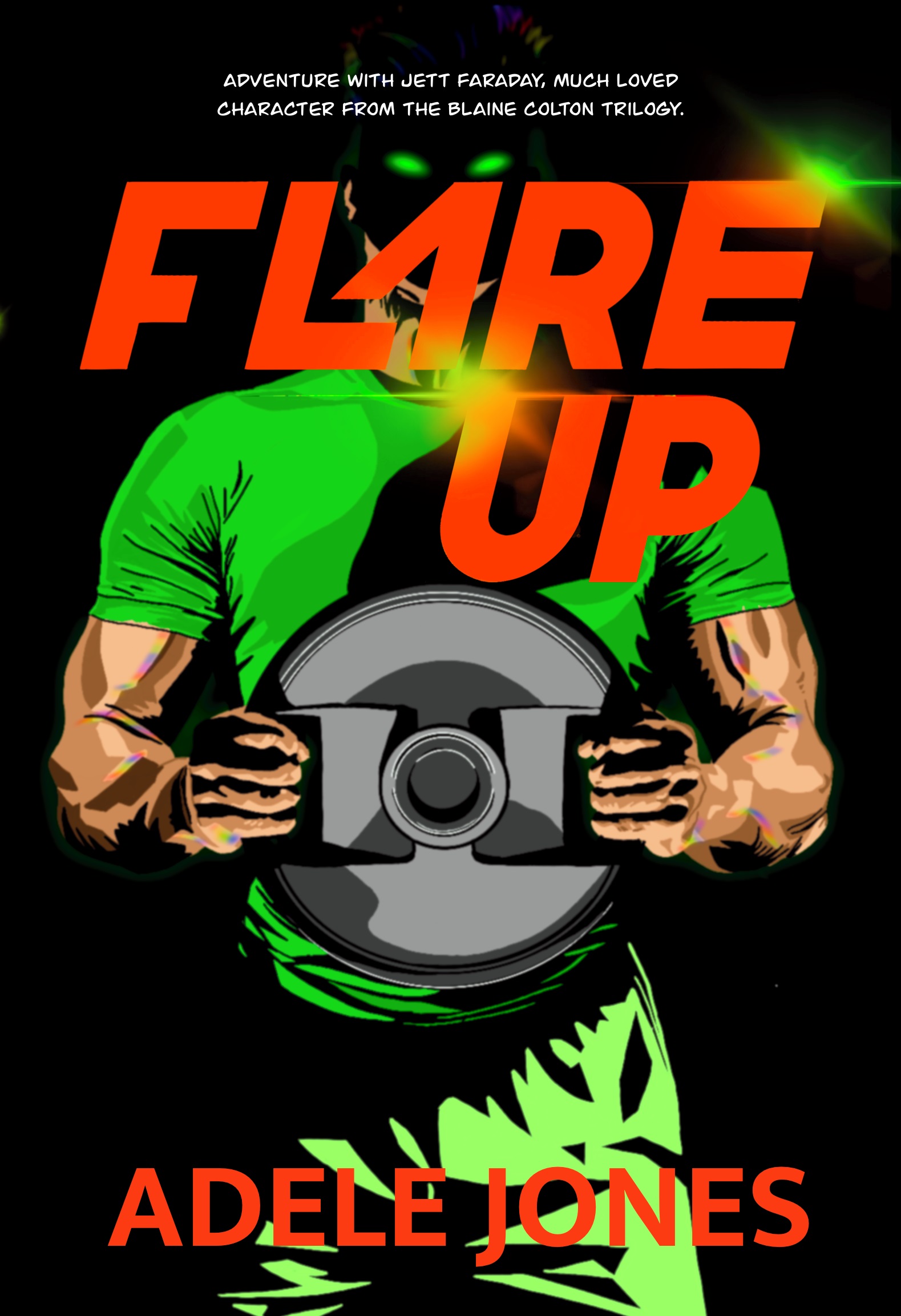 To catch you up, I have FINALLY released Jett Faraday’s story,